
A Data-Driven Look at Data Center Job Creation
Understanding Employment in Data Center Construction, Operations & Maintenance

We’ve looked at trades that work within the growing Data Center phenomenon.
Our Tuesday Trades feature has covered HVACR technicians, who install, operate and maintain the massive systems needed to cool the servers and buildings. We’ve written about technicians who maintain the power and control systems. So we’ve reported on who is doing what within the industry.
But it’s time to climb to 30,000 feet and understand what’s happening on a macro scale.
Let’s ask some basic questions like:
What is a Data Center?
How many Data Centers have been--and are being--built?
How many construction jobs are created with a typical hyperscale data center?
How many ongoing O&M jobs are created once the center is up and running?
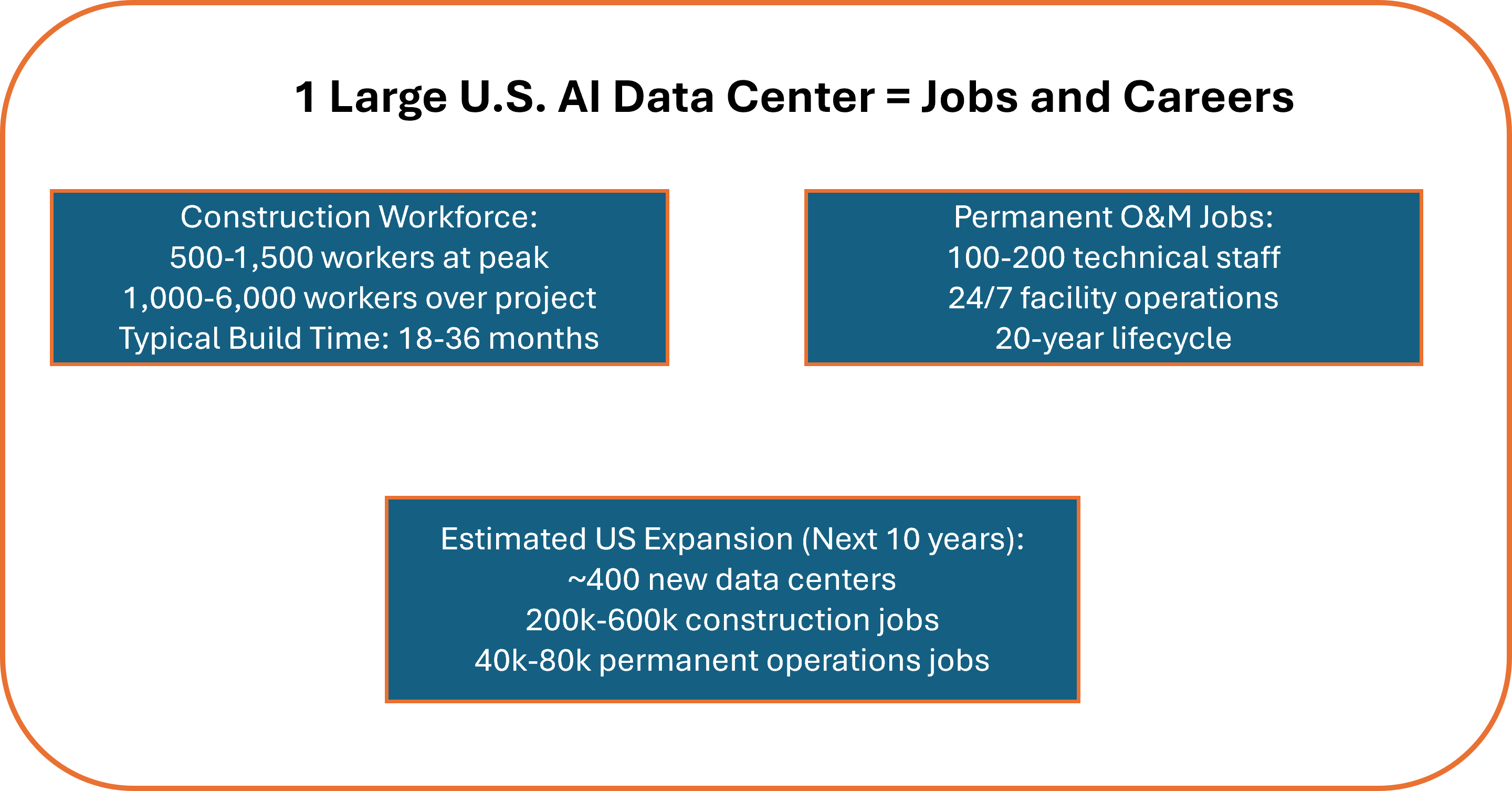
Here’s a preview of the job-creating potential for this emerging industry:
Understanding the Data Center
Every AI computing system runs inside large computing facilities known as data centers. These buildings house thousands of servers and specialized AI chips, supported by complex electrical systems, industrial cooling equipment, fiber networks, and backup power infrastructure.
And someone has to build all of that.
Across the United States, the rapid expansion of AI computing is driving a surge in new data center construction. Over the next decade, this infrastructure buildout could create hundreds of thousands of skilled trades jobs.
For students exploring trade career paths, the AI revolution will require building the infrastructure that makes AI possible.
How Many Data Centers Will be Built?
The United States already leads the world in data center infrastructure.
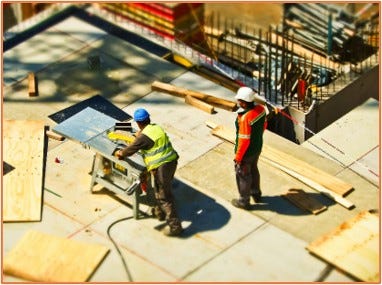
Today there are roughly 5,000–5,300 data centers operating across the country, ranging from smaller regional facilities to enormous hyperscale campuses run by major technology companies.
Some of the largest operators include:
Amazon Web Services
Microsoft
Google
Meta Platforms
Apple
As artificial intelligence applications grow, these companies are investing billions of dollars in expanding computing capacity.
Industry forecasts suggest the United States could see around 400 new large data centers built over the next decade to support AI and cloud computing demand. Each of these facilities represents a major construction project.
Constructing an AI Data Center Requires a Large Skilled Workforce
Modern data centers are some of the most complex buildings constructed today.
A single large facility may include:
Massive electrical substations
Backup generators and battery systems
Advanced cooling infrastructure
Miles of fiber optic cabling
Sophisticated mechanical systems
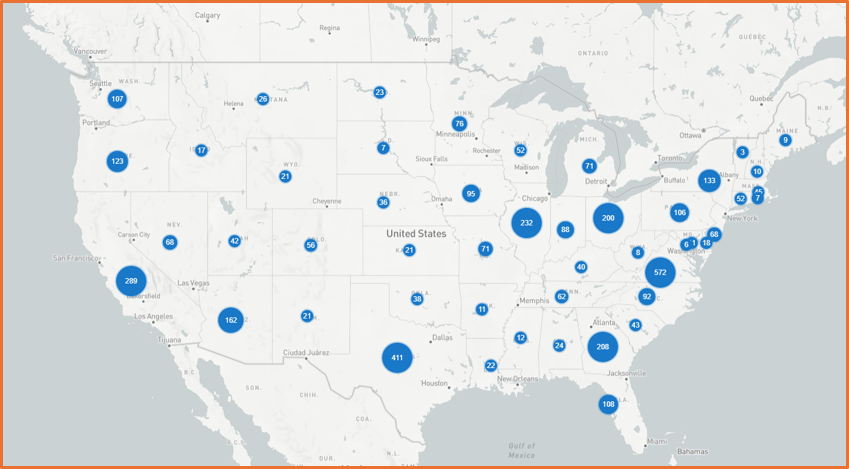
Because of this complexity, building a data center requires a large number of skilled trades workers.
Industry estimates show that a typical large data center construction project employs:
500 to 1,500 workers at peak construction activity.
Over the full construction cycle—typically 18 to 36 months—many more workers rotate through the project. In total, a single facility may involve 1,000 to 6,000 construction workers over time.
These workers include those shown in the following graph:
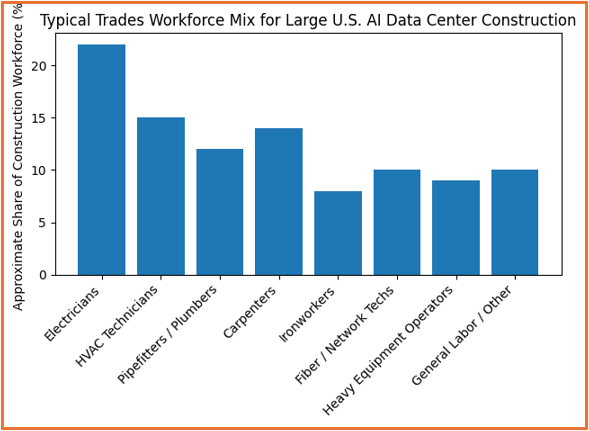
Illustrative workforce distribution based on industry reports from Uptime Institute, Turner Construction, JLL, and U.S. Bureau of Labor Statistics data on industrial construction trades.
How Many Construction Jobs Could AI Data Centers Create?
If the United States builds roughly 400 new large data centers over the next decade, the workforce impact becomes significant.
With 500–1,500 construction workers per project, the AI infrastructure boom could generate approximately 200,000 to 600,000 construction job placements across the United States.
These jobs are temporary in the sense that they last for the duration of the construction project. However, because projects typically last 18–36 months and many regions have multiple data centers under construction at the same time, skilled workers often move from one project to the next.
Major data center regions such as Northern Virginia, Dallas–Fort Worth, Phoenix, and Columbus already have multiple facilities being built simultaneously, creating sustained demand for skilled trades.
Who Builds These Data Centers?
These firms frequently build hyperscale and AI data centers for the large cloud companies.
Turner Construction
One of the largest data center builders in North America. Turner has built facilities for hyperscale operators across Virginia, Texas, Arizona, and other major markets.
DPR Construction
A leading contractor specializing in mission-critical infrastructure, including hyperscale and enterprise data centers.
AECOM
A global engineering and construction management company involved in designing and managing large infrastructure projects, including major data center developments.
Other major builders
Holder Construction
Whiting-Turner Contracting Company
Clark Construction Group
These companies coordinate the large workforce of electricians, HVAC technicians, pipefitters, and other trades involved in building data centers.
Data Centers Also Create Long-Term O&M Technical Jobs
Once construction is complete, data centers still require a permanent workforce to operate and maintain the facility. Data centers run 24 hours a day, 365 days a year, which means their systems must be constantly monitored and maintained.
A typical large data center employs roughly:
100 to 200 permanent workers.
These roles include:
Electrical technicians
Mechanical and HVAC technicians
Critical facilities engineers
Network technicians
Security staff
Power plant technicians
Operations & Maintenance managers
If approximately 400 new data centers are built in the U.S. over the next decade, that could create 40,000 to 80,000 long-term technical operations jobs.
These positions often offer strong wages and career advancement opportunities. Experienced data center technicians can earn $80,000 to $150,000 per year, depending on specialization and experience.
The Bottom Line
Artificial intelligence may be powered by software, but it depends on massive physical infrastructure.
As we’ve seen, behind every AI system is a network of data centers that rely on electricians, technicians, and skilled trades professionals who make that infrastructure possible.
As the United States continues building the facilities that power the AI economy, those workers will play a critical role in shaping the future.
Sources
Brookings Institution — The Future of Data Centers
Uptime Institute — Global Data Center Staffing Forecast
U.S. Bureau of Labor Statistics — Construction Workforce Projections
Center for Strategic and International Studies — The Human Infrastructure Challenge of AI