
California Prison Training Programs
Transforming the "Livin' Hell" Into a Training Center

In 1969, country singer Johnny Cash recorded a live album at San Quentin Prison in California. The famous black and white images from “At San Quentin” are now iconic, which portray the rebellious Cash in front of hardened inmates. When he famously sang: “San Quentin, you’ve been livin’ hell to me,” the prison crowd erupts in cheers.

The San Quentin prison album was Cash’s second: the first was “At Folsom Prison” recorded a year earlier. That album revitalized the singer’s career and made him a hero of prison inmates around the country.
First opened in 1852, San Quentin is California’s oldest prison, and along with its sister institution Folsom Prison, one of its most notorious. Until recently San Quentin housed Charles Manson, and was California’s only death row prison.
But no more. Governor Gavin Newsome instituted a controversial moratorium on the death penalty in 2019 and demolished the famous execution chamber in 2024.
In place of the old execution chamber and death-row cell blocks, a new rehabilitation facility has been opened on the San Quentin prison grounds.
On February 20th, 2026, Governor Newsome cut the ribbon on the new San Quentin Rehabilitation Center (SQRC), which hopes to provide transition services for soon-to-be released inmates from the prison.


The $239 million center is modeled after Scandinavian prison systems, which are more focused on rehabilitation than retribution. According to the governor’s office, the new 81,000-square-foot Learning Center “nearly triples available classroom and programming space at SQRC and establishes a campus-style environment dedicated to education, workforce training, media, and reentry preparation.”
Setting aside the familiar red-blue political arguments, the concept of helping prisoners transition from prison system into the outside world should be encouraged. Learning marketable trade skills while in prison will make recidivism less likely and should benefit the ex-inmate as well as the public at large.
The new facility incorporates three interconnected buildings:
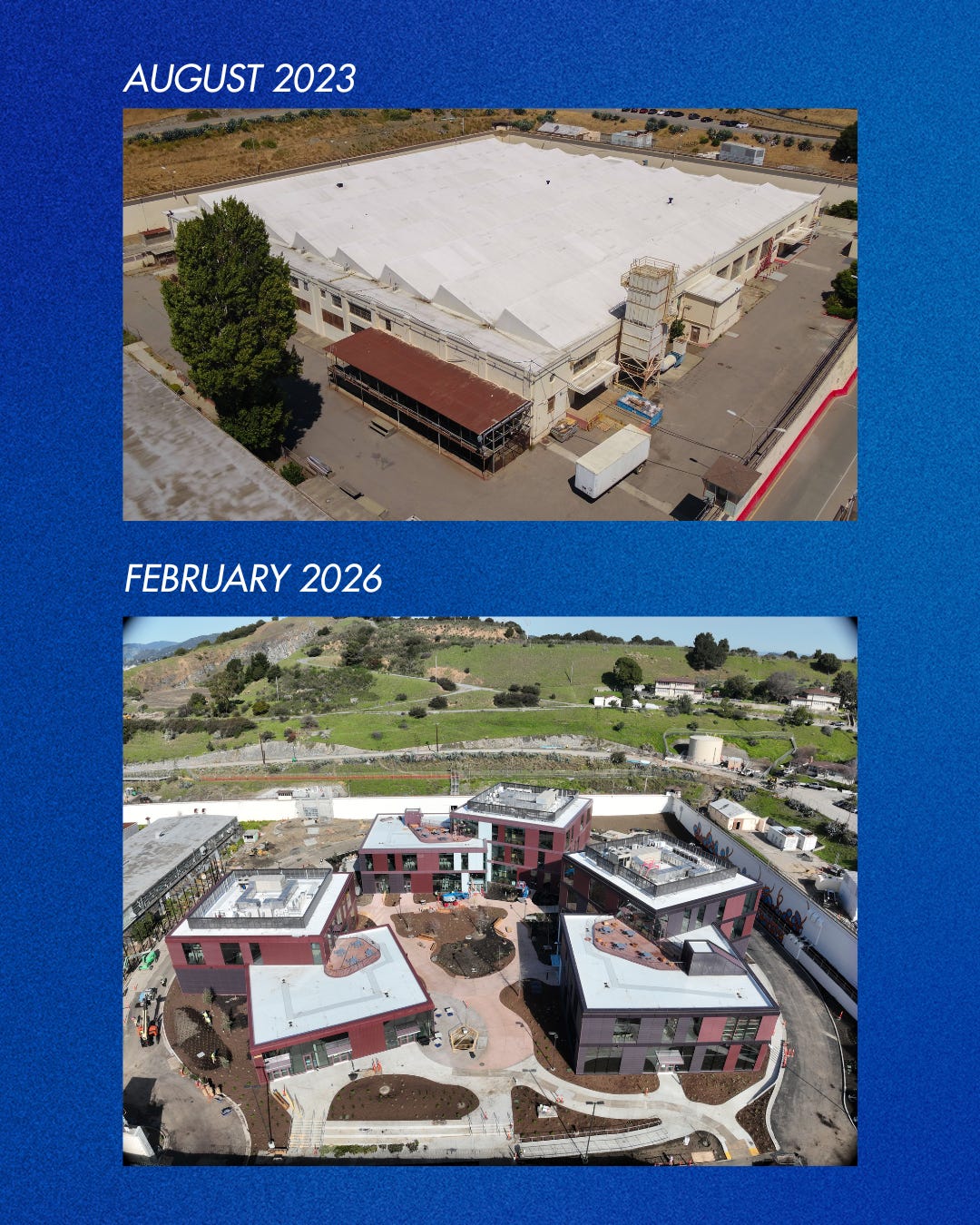
Building A – Technology and Media Center
A reentry center on the ground level — reinforcing that preparation for release begins on day one.
Podcast studios, television production facilities, and recording spaces supporting nationally recognized programs like Ear Hustle and Uncuffed
Coding instruction through partners like The Last Mile
Building B – Education Hub
Partnerships with Cal State LA, UC Berkeley, and Mt. Tamalpais College
Classrooms supporting high school completion and college-level coursework.
Expanded library and reading spaces.
Building C – Community and Workforce Space
Multi-purpose gathering hall, café, and store to normalize social and vocational experiences.
Outdoor classrooms with views of the Bay — the first time in years many will be able to see the water they’ve long been able to hear and smell.
The complex was designed and informed by more than fifty stakeholder meetings, including incarcerated residents and staff.
According to the architectural firm responsible for the design, the buildings use natural light, open sightlines, green-building principles, and campus-style courtyards to create an environment grounded in dignity and accountability.
But let’s look at the proposed training programs and see how this new rehabilitation center could be improved.
What’s Included – and What’s Not
We’ll focus on Building A, which houses the Technology Center. The press release touts the following skills programs: “podcast studios, television production facilities, and recording spaces supporting nationally recognized programs like Ear Hustle and Uncuffed,” and “Coding instruction through partners like The Last Mile.”
These training programs are useful for an artistic and media career and help the inmates tell their stories through music and podcasts. That’s great as far as it goes, but VoTech News is more interested in preparing these inmates for good paying trade skills.
But we don’t see any mention of HVAC, construction, welding, or other hands-on trade skills. We’d like to see a greater focus on these much-needed skill sets.
Folsom Prison Blues?
At Folsom Prison just 100 miles away, the California Correctional Training and Rehabilitation Authority (CALCTRA) system recently graduated 126 inmates with trade certifications. They seem to be ahead of San Quentin in skills training.
Louis Frazier graduated from CALCTRA’s Metal Fabrication and Computer-Aided Design program at FSP. He credits his seven years of job training for helping him find employment when he returned to his community in 2022.
“At my very first interview, I didn’t walk in with a resume. I walked in with my CALCTRA apprenticeship certification. The skills behind that certificate spoke for me, and I walked out that day with a job,” said Frazier.
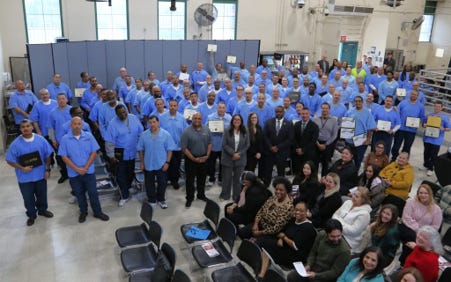
We’re not sure why that program is not mentioned in the San Quentin press release, but that looks to be the right focus for inmate transition programs.
Let’s look at Building C, where the press release mentions partnerships with Cal State LA, UC Berkeley, and Mt. Tamalpais College.
The most encouraging of these may be the Mt. Tamalpais College program, which provides a directory service for other colleges including trade schools. This link provides more information on this program.
College or Trade Schools?
Otherwise, the San Quentin and Mt. Tamalpais programs seem geared toward obtaining an Associate degree, and preparing the students for a four-year Bachelor degree through basic junior level math and writing classes.
These are all good programs, and as we’ve discussed before, if a four-year degree is the ultimate goal, then building transferrable skills and credits is essential.
But what seems lacking in the SQRC is a hands-on skills program like the one at Folsom Prison. The Folsom program gives inmates a chance to develop some skills, see what they enjoy, and eventually gain certification.
We understand the security concerns: CNC machining is a great skill, but a lot of dangerous items can be machined when nobody’s looking.
However, prisons are in the business of security, and with modern metal detectors, CCV TV and AI technology these risks can be minimized. If Folsom can do it, so can San Quentin.
We’re encouraged by these kinds of initiatives and wish California the best. In future posts we’ll look at other states and what their prison programs offer in terms of vocation and technical education.