
Riding the Rails
Jobs in the Rail Industry Part 1: The Original Equipment Manufacturers

This week we ride the rails to learn more about the massive U.S. rail industry.
Like most industrial businesses, we’re going to divide this analysis into two main categories: new build, and aftermarket (Operations & Maintenance).
This Part 1 will review the new equipment OEM business. Our next article will discuss aftermarket services.
The distinction is important for the trades because there are jobs available in both sectors, depending upon the geographic preferences and skill sets of the trades persons.
But let’s take a quick look back at how we got here, and what the future looks like for this continent-spanning industry.
The Golden Spike
The modern U.S. rail industry traces its origins to the completion of the Golden Spike ceremony at Promontory Summit, Utah, in 1869, which linked the continent and transformed railroads into the backbone of American commerce and travel.
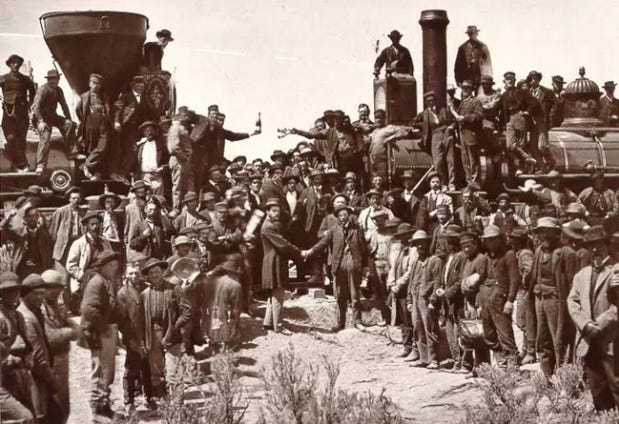
For decades afterward, rail dominated both freight and passenger movement, enabling westward expansion, industrialization, and national markets. By the early 20th century, railroads carried the vast majority of long-distance passengers and goods.
During World War II they were indispensable—moving millions of troops and enormous volumes of equipment across the country.
After the war, however, the system began to diverge. Federal investment in highways (the Interstate Highway System) and the rapid rise of commercial aviation pulled passengers away from trains, leading to the creation of Amtrak in 1971 to preserve a reduced national passenger network.
As American Affairs magazine writes:
The Interstate Highway System, authorized in 1956 and substantially complete by the late 1960s, made long-distance automobile travel fast, comfortable, and predictable.
Jet aviation, commercially viable from 1958, collapsed the premium long-haul market almost overnight: while rail travel still led aviation in the mid-1950s, by 1965, Americans were traveling four times as many miles by air as they were by intercity rail.
The train’s competitive niche, faster than driving and cheaper than flying, disappeared when highways made driving faster and jets made flying cheaper. Rail passenger numbers fell by half between 1945 and 1960, then halved again by 1970.
Railroads responded rationally: they exited a passenger rail business that was bleeding money.
The U.S. is a freight rail superpower
Freight rail by contrast reinvented itself, relying on scale and favorable rail networks between major hubs and manufacturing centers. It soon became one of the most efficient and productive freight systems in the world.
Today, U.S. railroads are overwhelmingly focused on moving bulk goods and intermodal freight across long distances, while passenger rail plays a much smaller role than in Europe or Asia.
The bottom line is that the U.S. rail moves roughly 4–6 times more freight than Europe.
The United States has the most freight-intensive rail system in the world. American railroads move roughly five times more freight than Europe’s entire network and carry over 40% of the nation’s long-distance cargo by ton-mile—far more than any other mode.
While European railways are built around moving passengers, U.S. rail is a heavy industrial logistics machine, optimized for hauling bulk goods across a continent. That difference drives a vast domestic workforce, from locomotive manufacturing and railcar production to the crews, mechanics, and infrastructure teams that keep the system running.
U.S. Locomotive Original Equipment Manufacturers (OEMs)
After years of turbulent market conditions, the U.S. manufacturers have consolidated into two main players: Wabtec (ex-ALCO and GE Transportation); and Progress Rail (ex-ElectroMotive Division – EMD of General Motors).
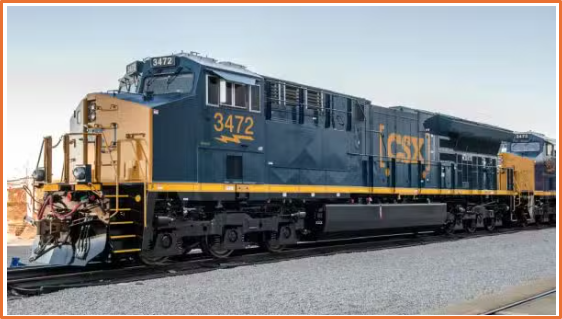
These two powerhouses require skilled trades workers for both their factories (new build) as well as aftermarket (long-term operations and maintenance).
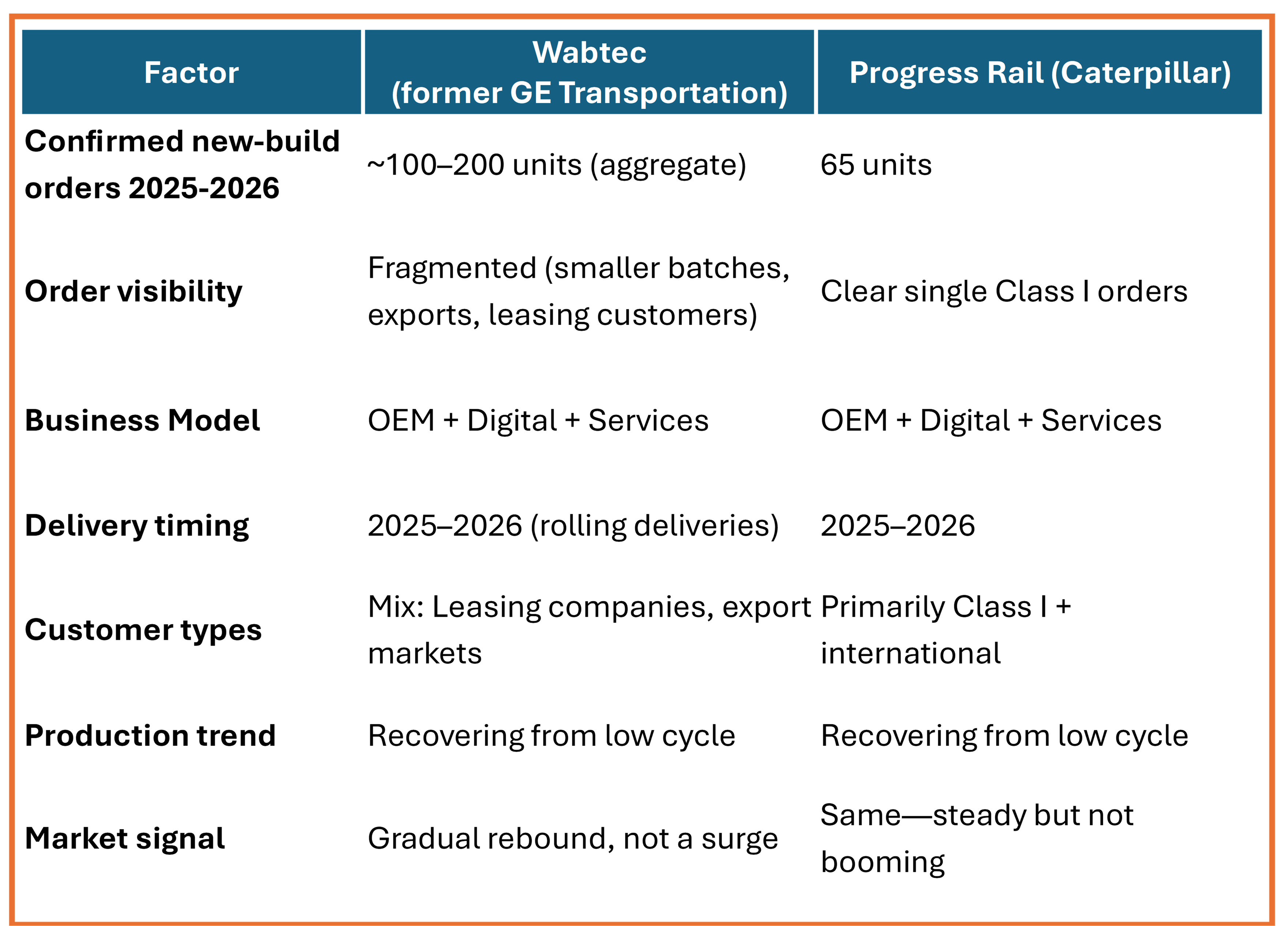
Wabtec enters 2026 with a record $27 billion backlog and robust growth across freight, transit, and digital systems, giving it multi-year production visibility.
Progress Rail, while less transparent due to its integration within Caterpillar, is also benefiting from a strengthening order environment, with new locomotive deals and long-term service contracts signaling steady demand.
Across both companies, the real story is not just new locomotive builds, but a sustained wave of fleet modernization and maintenance that is driving jobs across manufacturing and skilled trades.
Supply Chain Support Network
And we can’t forget the adjacent industries that support rail as well.
The various supply chain companies supply steel, electric generators, control systems, signaling devices and instrumentation. These industries are integral to the manufacturing and upgrading of locomotives.
Each locomotive pulls in:
Engines, alternators, traction motors
Castings, fabricated steel, wiring harnesses
Electronics, software, control systems
For 100 locomotives:
~800–1,800 supply chain jobs
The Trades Person Take-Away
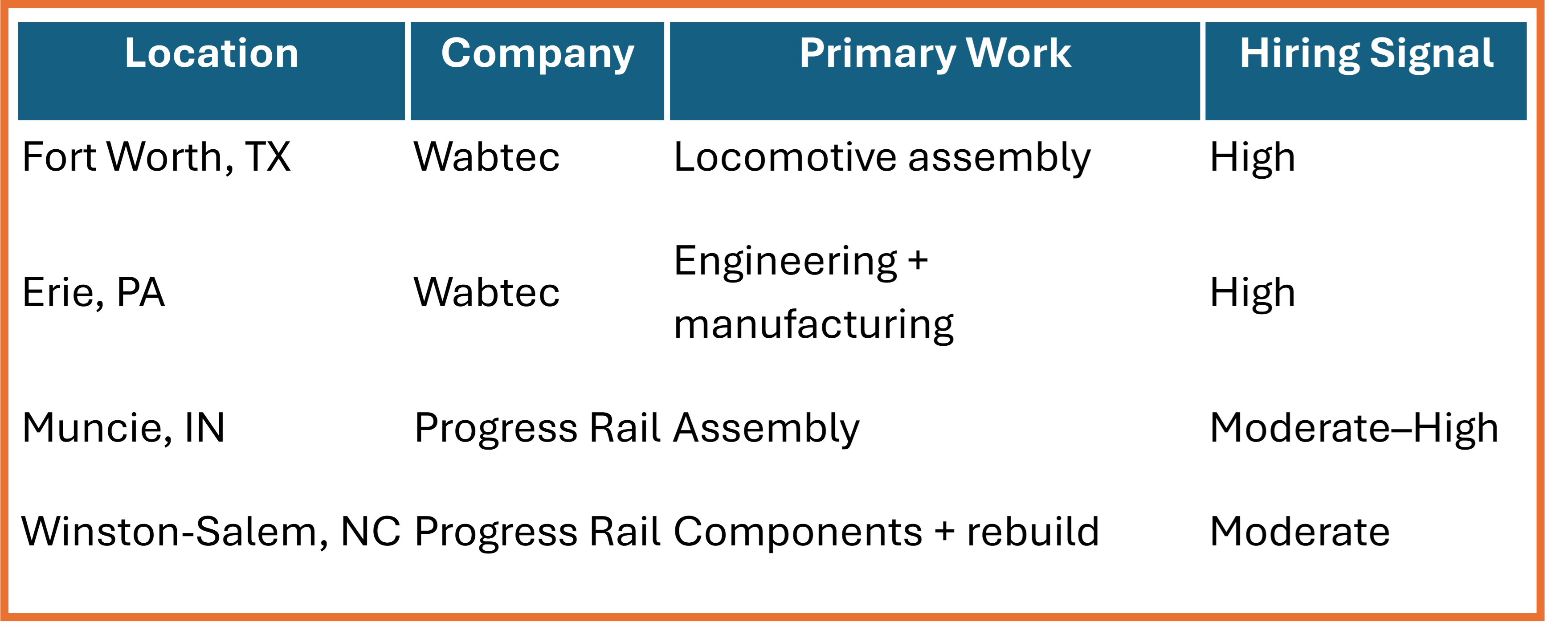
The primary locations for factory skills sets are near the main OEM manufacturing centers in Fort Worth TX, Muncie IN, Erie PA and Winston-Salem, NC.
A certification path in Electrical trades, welding, controls & instrumentation will be worth pursuing at these locations.
And as we’ve discussed, it’s not just factory work. Our next article will discuss the aftermarket – O&M business. These are more geographically dispersed and are available not just from the OEMs but the end operators as well.