
The Certification Toolkit
Giving Yourself an Edge in the Hiring Process

I once hired a technician because he had a certificate he didn’t actually need.
That sentence needs a little explanation. Our company was hiring a mechanical technician, and we had a couple of good candidates but only one opening at that time.
Both candidates we interviewed were good. They had the experience, the training, and the basic certificates needed for their skill sets. And both came with a good reputation and work history.
However, one candidate had something on his resume that caught my eye. A TWIC card.
I asked, “Why would you need a Transportation Workers Identification Credential (TWIC) card when you spend all your time servicing pumps and engines far away from an airport or port?”
“You never know when you might need it,” was the practical answer.
He got the job.
We realized that we liked the kind of initiative that led this technician to go above and beyond, anticipating and preparing for a future need.
It turns out that less than a month later, we needed someone to survey some used equipment for sale at the Port of Baltimore, and we had just the person. He was available, trained and importantly, had the TWIC card in his pocket.
The lesson is it helps to equip yourself with other certifications that may not be immediately relevant to your skill set.
As a welder, for example, you finished your training, passed your exams, and earned your certification. That’s a real milestone. It gets you in the door.
But once you’re in the hiring pool, employers are usually looking for more than your core credential. They want people who can step onto a job site with minimal ramp-up, work safely, and take on a range of tasks. For example, if you have a forklift operator certificate, you’ve got an edge if that skill is needed.
That’s where a certification toolkit comes in. These are short, practical credentials that show you’re ready to work now, not just trained in a specific skill. Many are inexpensive, widely available, and can be completed in a day or two.
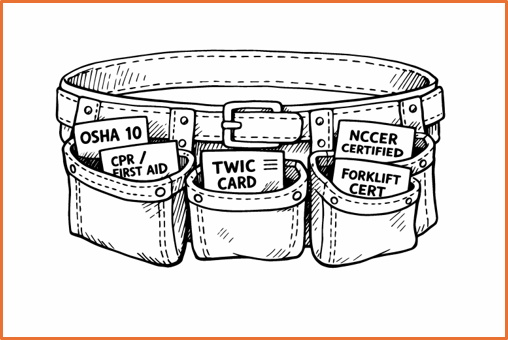
Here are the ones that come up again and again.
OSHA 10 (and OSHA 30)
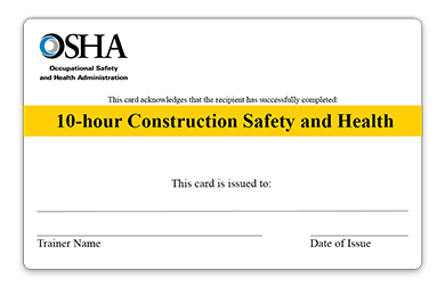
If you don’t already have OSHA 10, start here. On many job sites, it’s not optional.
The course covers hazard awareness, fall protection, PPE, and basic safety practices. It’s the common baseline across construction and industrial work.
OSHA 30 goes further and is worth considering if you want to move into lead or supervisory roles. You don’t need it on day one, but it signals that you’re thinking ahead.
CPR / First Aid
This is one of the quickest certifications you can pick up, and it carries weight.
Crews are often small. Job sites aren’t always close to immediate medical help. Having someone on hand who can respond in emergency matters.
It also shows a level of responsibility that employers notice, especially for new hires.
TWIC Card
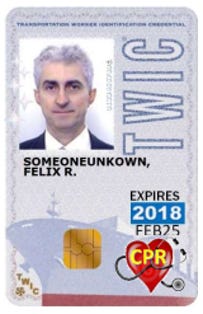
If you’re interested in industrial work, a TWIC card is a strong add.
It gives you access to secure areas like ports, refineries, offshore rigs, and some airport facilities. Those jobs tend to be more consistent and often pay better.
Even if you don’t need it right away, having it removes a barrier when those opportunities come up.
NCCER Credentials
National Center for Construction Education and Research (NCCER) certification validates a craft professional’s skills and safety knowledge in over 70 construction and industrial trades. NCCER certifications give employers a standardized way to understand your skills.
Not every company requires them, but many recognize them, especially on larger projects or multi-state operations. If your training program already connects to NCCER, make sure your credentials are documented.
Equipment Certifications (Forklift, Aerial Lift)
Being able to operate equipment makes you more useful on day one.
Forklift and lift certifications are often quick to earn and are frequently required for certain tasks. On a busy site, the person who can step in and run equipment tends to get more hours and more responsibility.
DOT Medical Card
If your work might involve driving trucks or transporting materials, a DOT medical card is worth having.
It’s a simple physical exam, but it opens up additional roles. That flexibility can make a difference as you move up.
Rigging / Signalperson
On larger job sites, moving materials safely is a constant task.
Rigging and signalperson certifications show that you can work around cranes and heavy loads without creating risk for the crew. Employers look for people they can trust in those situations.
Confined Space and Lockout/Tagout
These are more specialized, but they come up often in industrial settings.
They focus on working safely in hazardous environments and around energized systems. On certain jobs, these certifications determine who is allowed to be on the crew.
How to Build Your Toolkit
You don’t need everything at once.
Start with OSHA 10 and CPR. That covers the basics and makes you viable for most entry-level roles. After that, think about the type of work you want:
· Industrial or refinery work: add TWIC and confined space training.
· Advancement into lead roles: work toward OSHA 30.
· General job site flexibility: pick up equipment certifications.
· Each additional credential makes you easier to hire and easier to place.
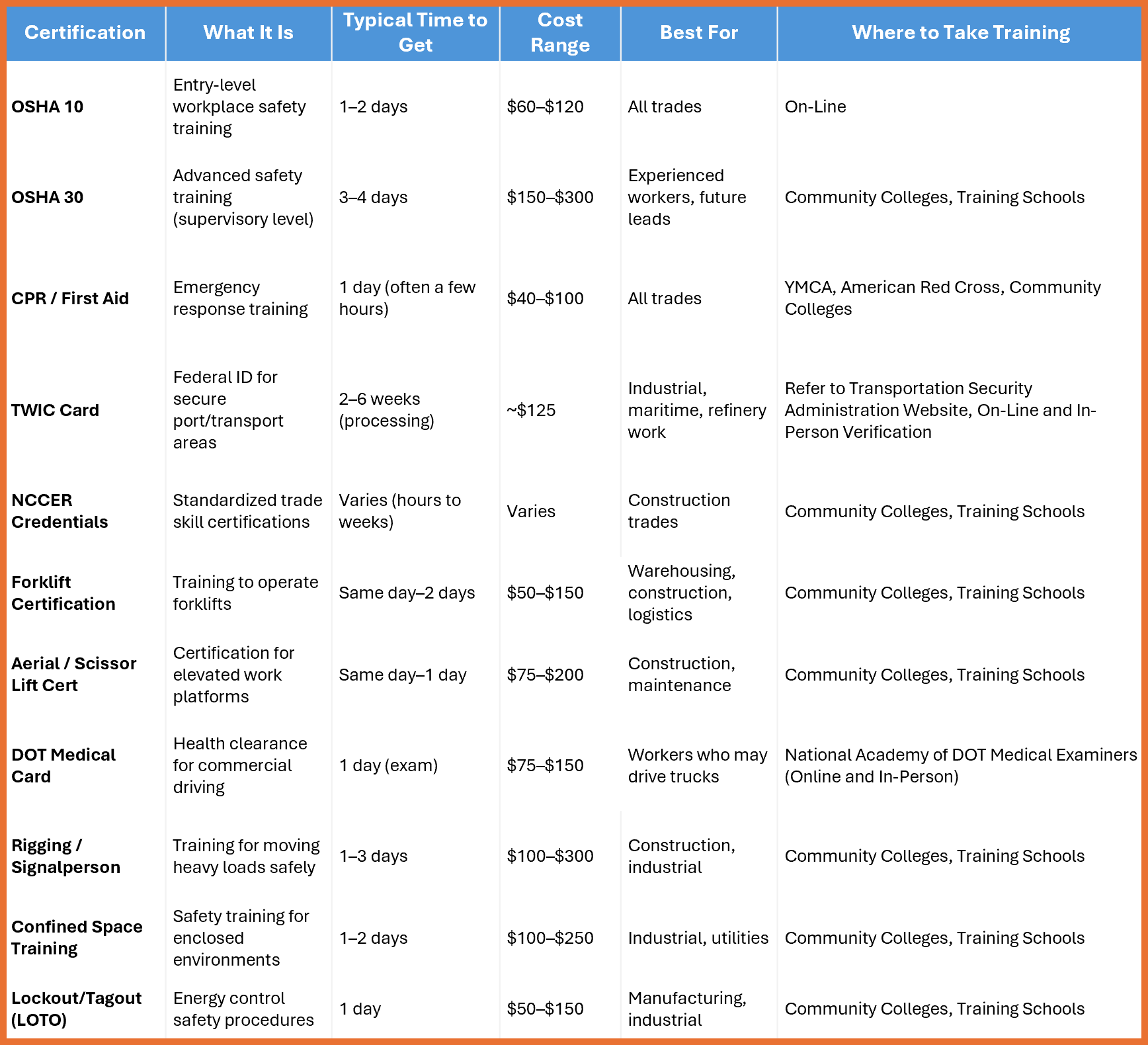
The Certification Table
Some Valid Push-Back to Adding Certs
I anticipate that some may say: “Why should a prospective employee pay for certifications? Shouldn’t companies pay for that?”
Ok, fair enough as far as it goes. Most reputable companies will and should pay for certifications that are directly related to the job, such as those specific requirements for offshore, maritime and road and transport jobs.
But I’m arguing that you first need to get in the door. A minimal, additional certification may get you hired where otherwise you’d be at parity with other candidates. Is it fair? Maybe not. But it does show a level of personal investment and initiative that sets you apart from other candidates.