
The Relocation Trap: Why the Workers Can’t Get to Where They're Needed
The Four Walls That Are Preventing Worker Relocation

VoTech News · Labor Market · June 2026
In April, we wrote about the Geographic Trap, covering how where a student lives shapes what futures they can even see. “The Opportunity Pathways and the Geographic Trap” looked at under-launched graduates stuck in pathway deserts: no community college nearby, no transit, no visible next step.
This is the sequel. Same trap, different life stage. Now those graduates are adults, and many of them are skilled tradespeople. But the Relocation Trap issues are, in many ways, more complex.
This Saturday, Ingalls Shipbuilding will hold a career day in Pascagoula, Mississippi. One of the crown jewels of American naval manufacturing, Ingalls builds destroyers and amphibious assault ships for the U.S. Navy. They are hiring, urgently, and for years to come. Welders. Pipefitters. Shipfitters. Electricians. The kind of skilled, well-paying, benefits-included careers that CTE programs are built to produce.
And across the country, there are qualified workers who would take those jobs, if only they could get there.
That gap between available work and available workers is the story of the American labor market right now. But it isn’t just a skills gap. It isn’t just a training gap. Increasingly, it is a relocation gap. The data behind it should alarm anyone who cares about workforce development, CTE policy, or the economic futures of working Americans.
We Used to Move. We Don’t Anymore.
In my day — and yes, I’m a Boomer, insert eye roll here — packing everything you owned into a cheap, beat-up car and driving halfway across the country for a job was just something people did. It was unremarkable. It was, in fact, the American story: you went where the opportunity was.

That story is over. The data is unambiguous.
2024: 11% of Americans changed their address.
1960s: 20% of Americans moved annually.
19th Century: ~33% of Americans moved annually.
According to U.S. Census data analyzed in 2025, Americans are moving at the lowest rate in over 75 years — the lowest since tracking began in 1948. As The Atlantic’s Yoni Appelbaum has written, the sharp decline in geographic mobility “is the single most important social change of the past half century,” tying it to lower entrepreneurship rates, fewer job changes, and worsening prospects for generational advancement.
We are becoming a country of workers and homeowners stuck in place.
The Walls of the New Geographic Prison
When we wrote about the Geographic Trap for graduates, the walls were physical and economic: no college nearby, no car, no transit, no visible pathway. For adult workers — including skilled tradespeople — the walls are different. But they are just as real, and in some ways harder to climb.
A note on those migration maps: Many readers will have seen the striking state-by-state migration charts showing households moving from California, New York, and Illinois toward Texas, Florida, and the Carolinas. Those maps are appear to contradict the 11% mobility figure. But they don't, quite.
Interstate migration involves roughly 2–3% of the U.S. population in any given year, a small subset of the broader mobility picture. The maps are visually dramatic because they show net flows between states, which amplifies the appearance of movement. More importantly for our purposes: the households driving those flows are disproportionately remote workers, retirees, and higher-income families who can absorb the cost of a long-distance move.
The licensed pipefitter with a 3% mortgage, a working spouse, and a mother nearby is largely not in those flows. He's in the 89% who didn't move at all — and that's exactly the worker Ingalls needs in Pascagoula.
Wall 1: The mortgage lock-in
This one is specific to the post-pandemic moment and its effects are enormous. During COVID, millions of Americans refinanced homes at historically low rates, at 2.5%, 3%, and 3.5%.
But today’s 30-year mortgage rate hovers around 6.27%. That gap has created what economists call the “lock-in effect.”
Over half of American homeowners currently hold a mortgage rate below 4%. Moving — even for a $10,000 signing bonus and a better career — means giving up that rate and taking on a payment that could be hundreds of dollars higher every month.
University of Pennsylvania researchers found that homeowners who are more locked in are less likely to move to nearby areas with high wage growth. The lock-in effect isn’t stopping people from wanting better jobs. It’s stopping them from being able to afford to take them.
The Federal Housing Finance Agency estimated that the lock-in effect prevented 1.72 million home sales between 2022 and 2024. Every one of those unsold homes is a worker who didn’t move.
Wall 2: The two-earner household
The beat-up car across the country worked, in part, because many households had one breadwinner making the call. Today’s worker is far more likely to be in a dual-income household. Moving for a job in Pascagoula or Newport News doesn’t mean finding one new job in a new city.
It means finding two — simultaneously — while also managing a move, possibly with children, possibly with aging parents nearby.
The arithmetic of family relocation has gotten dramatically harder. And the calculus is especially brutal for workers in their 30s and 40s, who are in peak earning years but also peak family-obligation years.
Wall 3: The licensing labyrinth
This is the wall that gets the least attention — and it is arguably the most fixable, and the most important for your CTE readers specifically.
A licensed plumber in Ohio cannot simply move to Virginia and go to work. In most cases, they must apply for a new license, meet Virginia’s specific requirements, potentially re-test, and wait through a processing period — all before earning a dollar. The same is true for electricians, HVAC technicians, and many other licensed trades.
The numbers on this are stark:
The interstate migration rate for workers in state-licensed occupations is 36% lower than for workers in unlicensed occupations. — Third Way / U.S. Census analysis
In the 1950s, roughly one in twenty workers required an occupational license. Today it’s one in five. Every new licensing requirement added over those decades was, in effect, a small wall built around a worker’s geographic freedom — with the sincere intent of protecting public safety, but the practical effect of protecting incumbents and immobilizing labor.
The irony is acute: the trades with the worst shortages, such as electricians, plumbers, HVAC techniciansm are precisely the trades most burdened by state-specific licensing that doesn’t travel.
Wall 4: The caregiver anchor
Less discussed but deeply real: as the Baby Boom generation ages, their adult children are increasingly tethered to home by caregiving responsibilities. A skilled welder in his 40s may have both a mortgage and an aging parent. The math of relocation includes not just the financial cost but the human cost of leaving family support networks behind.
The Richmond Federal Reserve noted in a May 2025 economic brief that moving rates have declined within every age group over the past 30 years — but the caregiver dynamic disproportionately affects the 35–54 cohort, exactly the experienced tradespeople employers are most desperate to hire.
What This Means for Ingalls, Newport News, and Every Employer Competing for Trades Talent
We covered signing bonuses in our last piece — the $5,000–$15,000 packages that HVAC recruiters now describe as “standard, not exceptional.” Newport News Shipbuilding offering $10,000 for experienced CNC machinists. Plumbers commanding $3,000–$10,000 depending on license level and market.
Those bonuses are, in part, employers’ attempts to buy their way through the walls of the immobility trap. And it isn’t always working.
Consider the complexity of the problem from an employer’s perspective. You need a pipefitter in Pascagoula. There is a qualified pipefitter in Columbus, Ohio. He has:
A 3.1% mortgage on a house worth $40,000 more than when he bought it
A spouse who is an RN with a job and seniority at a local hospital
A Louisiana pipefitter’s license requirement he’d need to satisfy before starting
A mother with early-stage dementia twenty minutes from his current house
A $5,000 signing bonus doesn’t move them. It might not even be worth the conversation.
This is why signing bonuses alone are an incomplete strategy. The employers winning the talent war in 2026 — and the policy frameworks that will actually close the workforce gap — need to engage with the mobility problem directly, not just try to price over it.
What Actually Works: Lessons From Programs That Remove the Geographic Barrier
In our Geographic Trap piece, we highlighted programs that work precisely because they remove the geographic constraint rather than try to overcome it.
Those same principles apply to adult workers. The employers making the most progress on the mobility problem are the ones who have recognized that relocation is a product to be designed, not an obstacle to be cleared with a bonus check.
Provide spouse or partner employment placement programs. Help the “family” relocate and find a job, not just the pipefitter. Make counselors part of the recruitment process.
Structure employee benefits programs to include at least some extended family long-term care. This is not an easy one, but I’ve not seen it discussed much in the literature.
Assist license reciprocity for those whose licenses won’t transfer. Employee a semi-retired tradesperson to take this on, someone who knows the ropes, and who to talk to in the local union halls and permit offices.
Newport News Shipbuilding is arguably the best current example. Their hiring model for 2026 high school graduates includes:
A structured trainee program (three weeks, paid training after acceptance)
Competitive entry-level wages with weekly paychecks
$500 sign-on plus $500 relocation assistance for candidates more than 50 miles away
Benefits from day one, including an on-site health center
A defined career ladder visible from the first interview
For experienced welders relocating from out of state: $5,000 sign-on plus $5,000 relocation assistance covers a lot of the relocation anxiety. It covers moving costs, bridge housing, and the financial friction of transition. It de-risks the move.
And What About License Reciprocity
As we mentioned above, one structural fix exists that would unlock the relocation trap immediately, without training a single new worker: universal occupational license recognition across state lines. Twenty-eight states have moved in this direction, but not quickly enough.
In a dedicated piece next week, we'll explore why the other twenty-two states haven't, and who's fighting to keep it that way.
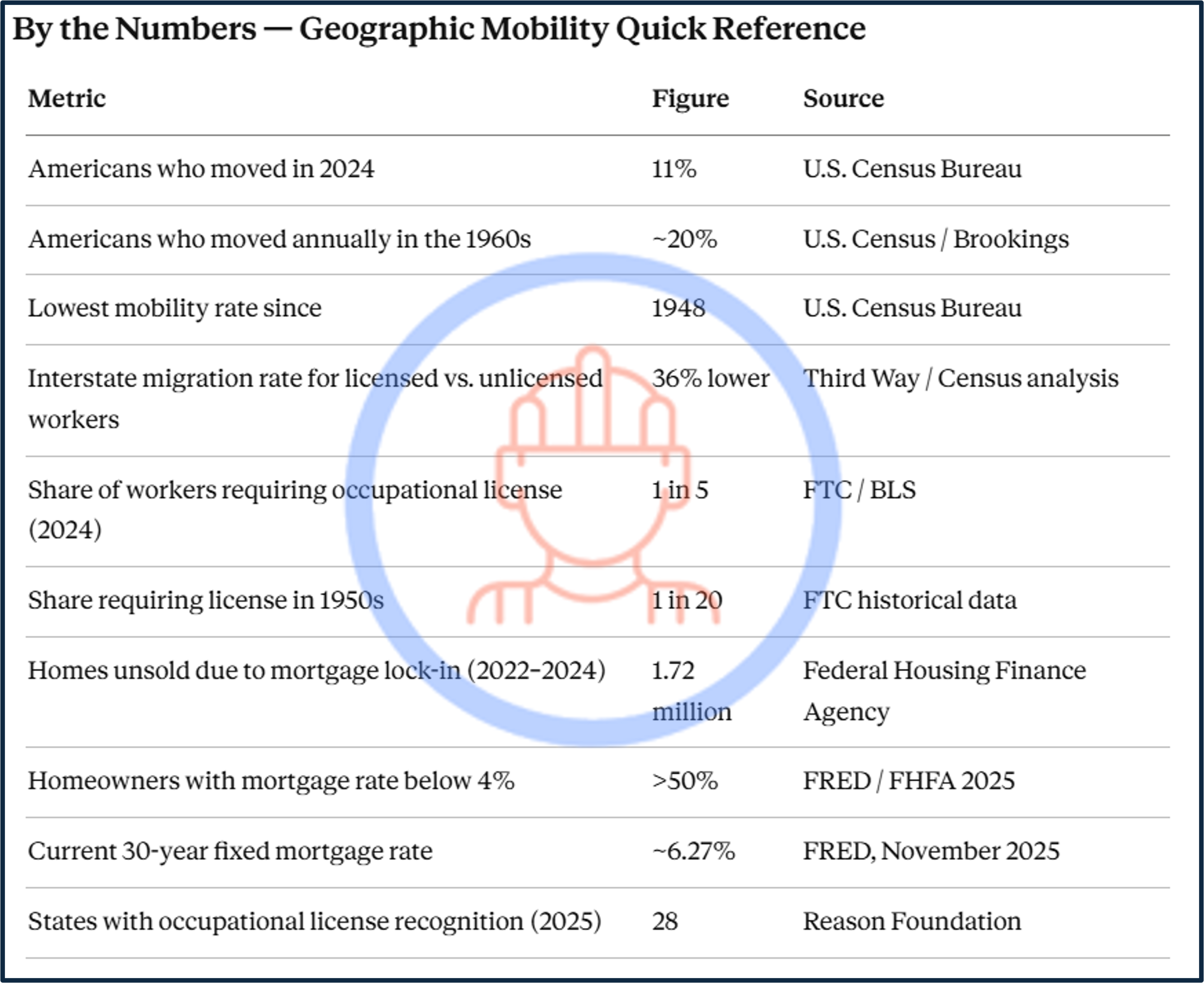
By the Numbers — Geographic Mobility Quick Reference
The table below sums up the issue. It would benefit all the stakeholders in the CTE space to improve relocation mobility, and improve access to higher paying, long term careers.
Related reading: “The Opportunity Pathways and the Geographic Trap” — VoTech News, April 2026. And our recent research brief: “Time to Sign: The Bonuses Available to Skilled Trade Workers” — VoTech News, June 2026.
Sources: U.S. Census Bureau geographic mobility data · Federal Reserve Bank of Richmond Economic Brief, May 2025 · Federal Housing Finance Agency lock-in effect analysis · Third Way “Stuck in Place” report · Reason Foundation state licensing report, August 2025 · FTC occupational licensing directive, February 2025 · American Action Forum licensing analysis · University of Pennsylvania (Fonseca & Liu) mortgage lock-in / labor mobility research · Brookings Institution geographic mobility data · Ingalls Shipbuilding / HII career day, June 2026 · Newport News Shipbuilding career listings, June 2026 · Blue Collar Recruiter 2026 shortage report.
VoTech News covers career and technical education, workforce development, and vocational policy for educators, counselors, policymakers, students, and business owners.
Moving expensive used to be largely covered by 5he new employer. Now that reserved for executive level only.